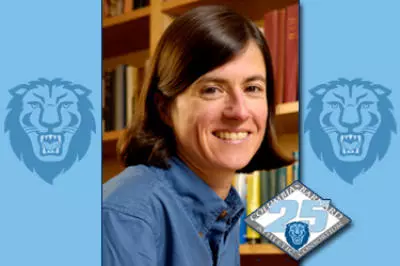
Silver Anniversary Honoree Profile: Ilaria Rebay '87CC
1/22/2009 12:00:00 AM | General
The 2008-09 year marks the Silver Anniversary of the Columbia-Barnard Athletics Consortium. In a year-long celebration, Columbia Athletics will pay tribute to the administrators, coaches and student-athletes who have brought distinction to Columbia Athletics. During the next few months, gocolumbialions.com will post profiles on the former student-athletes named to the "25 Most Influential" list and the Silver Anniversary honor roll. The next in the series is former track and field standout Ilaria Rebay '87CC.
After seeing her cross country team run terribly at the Ivy League Heptagonals her senior year, Ilaria Rebay knew she had to do something. In two weeks, the group of distance runners was scheduled to compete at the 1987 NCAA East Regionals, and after its lackluster performance at Heps, her coaches were threatening to not take the team to the event.
“It was embarrassing for us to run like total crap on our home course,” Rebay said of the result for Heptagonals, which was ran at Van Cortlandt Park just a few blocks north of Columbia's campus.
But, in her estimation, that didn't mean that her team didn't deserve a chance at redemption. So Rebay pleaded with the coaching staff to allow the Columbia team to run at regionals. After about a week of prodding, her persuasive abilities paid off and the coaches took the team to the NCAA Regional meet.
“We finally did end up going and it went well, everyone ran well,” Rebay says. “People ran good races and picked up a lot of places in the meet.”
Sticking up for an entire team to the coaches would be a tall task for anyone, let alone a self-described “shy girl” who didn't rock the boat too much. But Rebay, as a senior and a captain, felt it was her duty to do such a thing.
“Being elected captain, the highest honor you can have from your peers, forces you to speak up,” Rebay says. “It wasn't necessarily in my manner to do so prior to that.”
The quiet girl from Manhattan certainly had enough of a background and experience in sport to speak up whenever she wanted. An accomplished athlete at Spence High School in Manhattan, Rebay participated in six sports as a prep: track and field, volleyball, basketball, soccer, softball and field hockey.
Having grown up in New York City, Rebay saw Columbia as an obvious college choice. Having her father, Luciano, as a professor in the Italian department at the university didn't hurt, either.
“The free tuition definitely played a part of it,” Rebay says. “The fact that Columbia was admitting women for the first time made it a new and exciting time to be a student there as well.”
When Rebay stepped on the Morningside Heights campus in September of 1983, Columbia University and the athletics department were in full transition mode. The first coeducational class of Columbia College was enrolled in the fall, consisting of 45 percent women and 55 percent men. The year also marked the first of the Columbia-Barnard Consortium, a partnership that allowed Barnard College students to compete on Columbia's athletic teams.
Rebay took full advantage of the opportunity in Columbia athletics, joining the cross country, track and field, and volleyball teams her first year. Her high school experience was very beneficial in her first semesters at school.
“After my high-school experience (with six sports), it made Columbia almost a breeze,” Rebay says. “I liked having my day full, I liked team competition and really had fun so it was something I kept doing.”
As a first-year, Rebay made an instant impact on the volleyball court at a position that was foreign to her. At the Seven Sisters Tournament, Rebay was tossed into the starting lineup as a setter, a spot on the floor that she had never played. But the results were impressive enough to earn her a spot on the all-tournament team.
Though she concluded her Columbia volleyball career a bit prematurely, leaving the team after her sophomore season, Rebay continued on with cross-country. A three-time winner of Columbia's Scholar-Athlete Watch, the standout earned a spot on the GTE Academic All-America Team and was named the Varsity C award winner for cross country as a senior in 1987.
A graduate of Columbia College with a degree in mathematics, Rebay took a lot of biology courses in her time at the school and upon graduation in 1987, enrolled in Yale's Ph.D. program for biology to pursue a career in biological research in higher education.
“I always had a tendency toward academics,” Rebay says. “I liked the freedom that it allowed and I figured I would be involved somehow.”
Following completion of her doctoral class requirements in 1993, Rebay moved on to UC-Berkeley in California for postdoctoral work. In 1994, Rebay was awarded the John Spangler Nicholas Prize, which is handed out annually to outstanding doctoral candidates in experimental zoology. The following year, Rebay was bestowed another honor, a Burroughs Wellcome Fund Career Award for her investigation of yan function in Ras1-mediated signal transduction.
In 1997, Rebay moved on to Cambridge, Mass., where she was appointed an Associate Member of the Whitehead Institute for Biomedical Research and an assistant professor of biology at the Massachusetts Institute of Technology. There, she began to study how cells integrate complex messages from their environment, using eye development in fruit flies as a model system.
After seven years at MIT, Rebay landed at the University of Chicago and the Ben May Institute for Cancer Research, where she currently serves as an associate professor in the department of molecular genetics and cell biology. She is also a member of three committees devoted to genetics, developmental biology and a committee dedicated to cancer research.
Rebay has accomplished a tremendous amount in her professional career over the past two decades, but one thing that sticks out about her time at Columbia is an encounter with her father about a story in the Columbia Spectator, the school's student newspaper.
“They used to run a column called the ?Spectator Athlete of the Week,' and after the volleyball tournament my freshman year I won the award,” Rebay recalls. “My father picked up a paper that day and went to his office. He glanced at the column and couldn't figure out why they had named him Player of the Week. He didn't think that there could be another Rebay in the paper.”