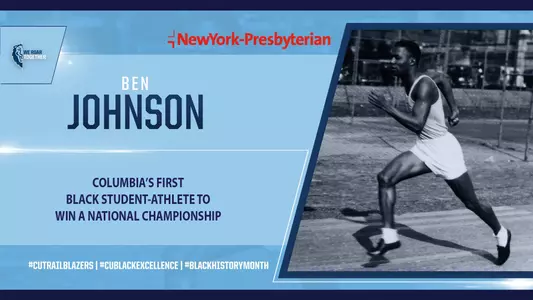
Columbia Trailblazer: Ben Johnson '39CC
2/1/2021 7:00:00 AM | General, Track and Field
Black History Month Feature PageBen Johnson Story, Columbia UniversityIvy 50 ProfileTimes Leader StoryCitizen's Voice StoryAthletic Hall of Fame Bio
Once known as the “World’s Fastest Human,” and nicknamed the “Columbia Comet,” Ben Johnson became the first Black student-athlete at Columbia to win an individual national title as he claimed the NCAA outdoor 200-yard dash in 1937.
BLACK HISTORY MONTH—Nicknamed the "Columbia Comet," Ben Johnson once held the title of "World's Fastest Human" after he shattered a number of world sprinting records and upset world champion Ralph Metcalfe and future Olympic gold medalist Jesse Owens during the 1930s.
Benjamin Washington Johnson was introduced to the track and field world as a junior at Plymouth (Pa.) High School in 1932, when he shattered the Pennsylvania state scholastic sprint records by winning state titles in the 100 yards (9.8) and 220 yards (21.4). He also won the state long jump title.
 In 1934, as a Columbia freshman, he upset Ralph Metcalfe, the world record-holder in the 100-yard dash and an eventual Olympic gold medalist, in the National indoor AAU 60-meter semifinal and ran a 49-second quarter-mile on the mile relay that won the Penn Relays' freshman race.
The next year, Johnson beat Metcalfe, Eulace Peacock and the famed Jesse Owens for the indoor AAU 60-meter championship, matching Owens' record of 6.6 seconds in the process. Unfortunately, Johnson missed most of the season with a torn hamstring.
The following summer, with his hamstring improved, the Columbia Comet was ready to take on Owens and the others at the Olympic Trials for a spot on the squad heading to Berlin for the 1936 Games. But a week before the Trials, he cramped up in a rumble-seat ride from Plymouth to Princeton for the National AAU Championships and arrived too late for a proper warm-up.
He strained a muscle in the first heat of the day; he pulled up after two strides, rendering him unable to compete at the Trials. Jesse Owens became the hero of the Games.
Johnson still had headlines in his future as he proved himself with a sensational 1937 campaign, winning AAU and IC4A titles, along with the NCAA 220-yard championship in a speedy 21.3 seconds. At the IC4A meet, he became the first athlete in the 20th century to win three events, taking the 100, 220 and broad jump. He became the first black track athlete to be a Heptagonal Games first-team performer and became Columbia's first-ever Black student-athlete to win a national title. He also became the second Black student-athlete in school history to earn All-America honors, following George Gregory (1931) and Columbia's first-ever Black Ivy League champion (1935).
Although he had missed the Olympics, Johnson embarked on a European tour following the season. As famed track and field journalist Jesse Abramson wrote in the New York Herald Tribune, "Then Johnson went abroad, beat the pick of Europe, sweeping 11 of 12 races, returning a world- record 10.2 for 100 meters twice with a favoring breeze. John P. Nicholson of Notre Dame, manager-coach on that European tour, called him the world's finest after seeing him run week after week in small towns, in world capitals, on good tracks and bad."
Johnson's finest performance occurred in his senior season. Competing at the 1938 Millrose Games in Madison Square Garden before 17,000 enthusiastic fans, Johnson ran a 6.2, 6.1 and 6.0 in the 60-yard dash, tying the world record, then breaking it and breaking it again. One report said he had actually been clocked in 5.9, but the timers dismissed that because they didn't believe a human could run that fast.
"With his final performance," Abramson wrote, "he wiped out all recorded 60-yard records, on boards, on dirt, with and without starting blocks, surpassing the feats of Loren Murchison, Jesse Owens, Ralph Metcalfe, Eddie Tolan, Emmett Toppino and all others."
Voted the outstanding performer by a panel of eight sportswriters, Johnson was hailed as "world's fastest human."
The rest of his senior season was lost because of a case of the measles, but he did sweep the 100 and 220-yard dashes at White City Stadium in London before 70,000 fans that summer.
There was no professional track and field in those days. Following his 1939 graduation from Columbia College where he majored in political science, Johnson taught history and coached track at Bordertown Manual Training School and did so for a few years before enlisting in the Army in December 1942. Johnson had a noted career in the U.S. Army, retiring from the service in 1968 as he became one of the first Black Americans to attain the rank of colonel. He earned a Master's degree from the University of Maryland in 1968.
Johnson was inducted into the Columbia University Athletics Hall of Fame in 2006.
Benjamin Washington Johnson was introduced to the track and field world as a junior at Plymouth (Pa.) High School in 1932, when he shattered the Pennsylvania state scholastic sprint records by winning state titles in the 100 yards (9.8) and 220 yards (21.4). He also won the state long jump title.
In 1934, as a Columbia freshman, he upset Ralph Metcalfe, the world record-holder in the 100-yard dash and an eventual Olympic gold medalist, in the National indoor AAU 60-meter semifinal and ran a 49-second quarter-mile on the mile relay that won the Penn Relays' freshman race.The next year, Johnson beat Metcalfe, Eulace Peacock and the famed Jesse Owens for the indoor AAU 60-meter championship, matching Owens' record of 6.6 seconds in the process. Unfortunately, Johnson missed most of the season with a torn hamstring.
The following summer, with his hamstring improved, the Columbia Comet was ready to take on Owens and the others at the Olympic Trials for a spot on the squad heading to Berlin for the 1936 Games. But a week before the Trials, he cramped up in a rumble-seat ride from Plymouth to Princeton for the National AAU Championships and arrived too late for a proper warm-up.
He strained a muscle in the first heat of the day; he pulled up after two strides, rendering him unable to compete at the Trials. Jesse Owens became the hero of the Games.
Johnson still had headlines in his future as he proved himself with a sensational 1937 campaign, winning AAU and IC4A titles, along with the NCAA 220-yard championship in a speedy 21.3 seconds. At the IC4A meet, he became the first athlete in the 20th century to win three events, taking the 100, 220 and broad jump. He became the first black track athlete to be a Heptagonal Games first-team performer and became Columbia's first-ever Black student-athlete to win a national title. He also became the second Black student-athlete in school history to earn All-America honors, following George Gregory (1931) and Columbia's first-ever Black Ivy League champion (1935).
Although he had missed the Olympics, Johnson embarked on a European tour following the season. As famed track and field journalist Jesse Abramson wrote in the New York Herald Tribune, "Then Johnson went abroad, beat the pick of Europe, sweeping 11 of 12 races, returning a world- record 10.2 for 100 meters twice with a favoring breeze. John P. Nicholson of Notre Dame, manager-coach on that European tour, called him the world's finest after seeing him run week after week in small towns, in world capitals, on good tracks and bad."
Johnson's finest performance occurred in his senior season. Competing at the 1938 Millrose Games in Madison Square Garden before 17,000 enthusiastic fans, Johnson ran a 6.2, 6.1 and 6.0 in the 60-yard dash, tying the world record, then breaking it and breaking it again. One report said he had actually been clocked in 5.9, but the timers dismissed that because they didn't believe a human could run that fast.
"With his final performance," Abramson wrote, "he wiped out all recorded 60-yard records, on boards, on dirt, with and without starting blocks, surpassing the feats of Loren Murchison, Jesse Owens, Ralph Metcalfe, Eddie Tolan, Emmett Toppino and all others."
Voted the outstanding performer by a panel of eight sportswriters, Johnson was hailed as "world's fastest human."
The rest of his senior season was lost because of a case of the measles, but he did sweep the 100 and 220-yard dashes at White City Stadium in London before 70,000 fans that summer.
There was no professional track and field in those days. Following his 1939 graduation from Columbia College where he majored in political science, Johnson taught history and coached track at Bordertown Manual Training School and did so for a few years before enlisting in the Army in December 1942. Johnson had a noted career in the U.S. Army, retiring from the service in 1968 as he became one of the first Black Americans to attain the rank of colonel. He earned a Master's degree from the University of Maryland in 1968.
Johnson was inducted into the Columbia University Athletics Hall of Fame in 2006.


Friday, September 11
Wednesday, February 04
Wednesday, November 05
Friday, October 10