2/6/2021 11:00:00 AM | General, Men's Basketball
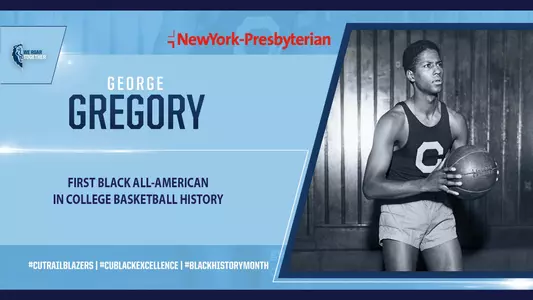
Columbia’s George Gregory became the first Black player to earn All-America status in college basketball history; He also is the first Black All-American in Columbia Athletics history.
BLACK HISTORY MONTH—One of the greatest basketball stars of his time, Columbia University's George Gregory made history when he became the nation's first Black player in college basketball history to earn All-America honors. He also became the first Black athlete in school history to earn All-America accolades in 1931.
After an outstanding 1930-31 season in which Gregory gained national acclaim, he was voted a Helms Foundation First Team All-American and was joined on the team by Purdue guard John Wooden, who later became the legendary UCLA basketball coach. In the end, Gregory was selected to numerous All-America squads that season.
 Standing 6-foot-4-inches tall while playing the center position, Gregory powered Columbia Basketball as he guided the Lions to back-to-back Eastern Intercollegiate League championships in 1929-30 and 1930-31. Columbia basketball games became a major attraction as the bulk of the Lions' contests were being played at World-Famous Madison Square Garden.
As the second Black American ever to play basketball at Columbia, Gregory scored 509 points in 62 games for the Lions in his fabulous three-year career. His 8.2 career scoring average was extremely high for that era. During his sophomore year in 1928-29, Gregory led the Lions to a fourth place finish in the EIL after he ranked fourth in the league in scoring as he finished with 155 points in 17 contests. As a junior in 1929-30, he was named captain of the Columbia basketball team and proceeded to lead the Lions to their first-ever Eastern League title. Serving once again as the Lions' captain during his senior year, he guided the Lions to a 21-2 record and a second straight league title. He was named first team All-Eastern League, his third straight honor in four years.
Though he had a full scholarship to attend Columbia, Gregory worked as a red cap in Manhattan's Penn Station. After completing his undergraduate degree, he played semi-professional basketball, earning as much as $150 a year, while earning his law degree at St. John's University School of Law as a night student.
While still an undergraduate, Gregory began a lifelong career battling juvenile delinquency and defending civil rights. He served as the boys' director for the largest youth project for Black Americans in the nation, the Harlem Center of the Children's Aid Society. He went on to hold administrative positions at settlement houses and youth clubs such as the Harlem Youth Center and the First Neighborhood House. He was a founding member of the NYC Youth Board in 1947.
From 1954 to 1968 Gregory was a commissioner on the Municipal Civil Service Commission, while spending 15 years in the office of the Manhattan Borough President. From 1968 to 1979 he was an assistant administrator of what is now the Department of Environmental Protection.
A graduate of DeWitt Clinton High School in New York City, Gregory took an active role in the community after graduation and continually maintained a connection to athletics.
Gregory, who is both a member of the Columbia Athletic Hall of Fame and New York Basketball Hall of Fame, passed away in Manhattan on May 11, 1994, at the age of 88.
After an outstanding 1930-31 season in which Gregory gained national acclaim, he was voted a Helms Foundation First Team All-American and was joined on the team by Purdue guard John Wooden, who later became the legendary UCLA basketball coach. In the end, Gregory was selected to numerous All-America squads that season.
Standing 6-foot-4-inches tall while playing the center position, Gregory powered Columbia Basketball as he guided the Lions to back-to-back Eastern Intercollegiate League championships in 1929-30 and 1930-31. Columbia basketball games became a major attraction as the bulk of the Lions' contests were being played at World-Famous Madison Square Garden.As the second Black American ever to play basketball at Columbia, Gregory scored 509 points in 62 games for the Lions in his fabulous three-year career. His 8.2 career scoring average was extremely high for that era. During his sophomore year in 1928-29, Gregory led the Lions to a fourth place finish in the EIL after he ranked fourth in the league in scoring as he finished with 155 points in 17 contests. As a junior in 1929-30, he was named captain of the Columbia basketball team and proceeded to lead the Lions to their first-ever Eastern League title. Serving once again as the Lions' captain during his senior year, he guided the Lions to a 21-2 record and a second straight league title. He was named first team All-Eastern League, his third straight honor in four years.
Though he had a full scholarship to attend Columbia, Gregory worked as a red cap in Manhattan's Penn Station. After completing his undergraduate degree, he played semi-professional basketball, earning as much as $150 a year, while earning his law degree at St. John's University School of Law as a night student.
While still an undergraduate, Gregory began a lifelong career battling juvenile delinquency and defending civil rights. He served as the boys' director for the largest youth project for Black Americans in the nation, the Harlem Center of the Children's Aid Society. He went on to hold administrative positions at settlement houses and youth clubs such as the Harlem Youth Center and the First Neighborhood House. He was a founding member of the NYC Youth Board in 1947.
From 1954 to 1968 Gregory was a commissioner on the Municipal Civil Service Commission, while spending 15 years in the office of the Manhattan Borough President. From 1968 to 1979 he was an assistant administrator of what is now the Department of Environmental Protection.
A graduate of DeWitt Clinton High School in New York City, Gregory took an active role in the community after graduation and continually maintained a connection to athletics.
Gregory, who is both a member of the Columbia Athletic Hall of Fame and New York Basketball Hall of Fame, passed away in Manhattan on May 11, 1994, at the age of 88.


Feature: 2026 Columbia Athletics Hall of Fame Recap
Wednesday, October 28
Feature: 9/11 Rememberance
Friday, September 11
Feature: National Girls & Women in Sports Day Panel
Wednesday, February 04
Lions Rewind: Sept. 26 - Oct. 24, 2025
Wednesday, November 05