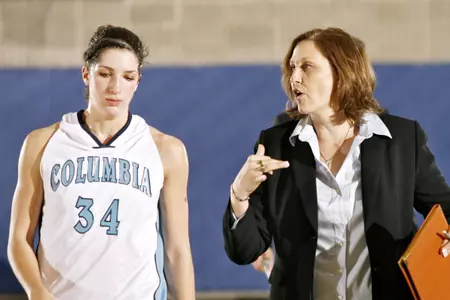
Coaches Corner: Women's Basketball Assistant Coach Katy Steding
1/13/2010 12:00:00 AM | Women's Basketball
Note: This article was originally published in the June 2009 issue of Lions Den.
Q: Your playing career speaks for itself - captain of Stanford's first national championship team in 1990, United States Olympic Gold Medalist for the in 1996 and a Women's National Basketball Association player. How and when did you begin playing basketball, and what sparked your interest in the game at a young age?
A: I started playing basketball in the third grade, about the time that the Portland Trail Blazers were making their NBA Championship run. There were no all-girls teams at that time, so I just talked two of my friends into playing in the boys' league. I came home from the first game crying because the boys took the ball away from me, but my mother said, "Well, you just take it right back!" The thought had not occurred to me before that, I guess!
Q: Prior to coming to Columbia, you were an assistant coach for the Atlanta Dream in the WNBA and head coach at Warner Pacific College in Oregon. How does coaching at the two different levels (professional vs. college) compare?
A: At the professional level, it is pretty much scouting each opponent and then getting to work with the players a little but it's game after game after game there. The thing I like the best about coaching at the collegiate level is the time spent working and talking with the players. At Columbia in particular, the student-athletes are so thoughtful about their game that it sometimes can actually get in their way. I just hope to help them bring their game to the next level and then bring home an Ivy League Championship!
Q: Many people around the globe dream of representing their country at the Olympics and not only did you get to compete in 1996, you won a gold medal. What were your feelings when the national anthem was being played as you stood on the podium?
A: Humility, mostly. The fact that I was part of this incredible team, that we were so blessed to play on the world's greatest stage for a time and everyone got to contribute in that game in particular; I was so joyful when I heard our anthem. I am still amazed sometimes that I was fortunate enough to participate. Now, when I hear our national anthem, I am filled with pride in remembrance of that time.
Q: Stanford, like Columbia, is a school that prides itself on its academic reputation. How has coming from a highly successful, academically strong Division I program helped you relate to the student-athletes here at Columbia?
A: First of all, anyone who can balance the demands of athletics and academics simultaneously at the Division I level deserves a tip of the hat at this point; it isn't easy no matter what school you're at. But the unique combination of being a student-athlete at a school like Columbia or Stanford is so extraordinary because you are achieving literally at the top of two competing disciplines, whereas most people have success in one area or another, not two at the same time.
I can relate to the members of the women's basketball team because I've been through it; I'm hoping that I'm a daily reminder to them that it is possible, that it won't kill them. I am constantly inspired, watching these young women deal with the rigors and stresses of the Columbia program on a daily basis, with so much effort and heart.