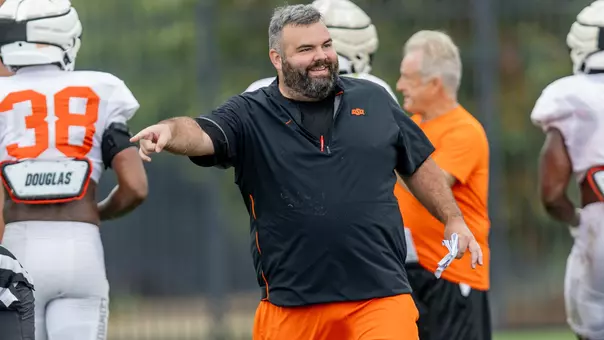
Photo by: Columbia University Athletics/Mike McLaughlin
The Coaches of Columbia Football
10/27/2020 12:22:00 PM | Football
CUFootball150 Feature PageVote for the CUFootball All-150 TeamBuy CUFootball150 MerchandiseColumbia Football Celebrates 150-Year AnniversarySubmit Your Favorite Columbia Football Memory or Moment
Over the last 150 years, Columbia Football has had 20 coaches serve as head coach of the Lions; Five Columbia head coaches have been inducted into the NFF Hall of Fame.
NEW YORK—This is the 13th story in a #CUFootball150 feature series on Historical Lists for Columbia Football. Today we look at the Head Coaches of Columbia Football. A total of 20 head coaches have guided the program through the years, while five have been inducted into the National Football Foundation Hall of Fame. Here is a look at each of the men who have served the Lions:
Follow Columbia Football: TWITTER | FACEBOOK | INSTAGRAM
GEORGE F. SANFORD (1899-1901)
Columbia's first-ever coach, Sanford guided the Lions to a successful three-year 23-11-1 record. Columbia called Sanford to revive a program that had been abandoned after the 1891 captain. His 1899 team defeated Yale for the first time, and it was at Columbia that Sanford developed the famous "Flying Hurdle Play," which saw Harold Weekes catapulted over the line of scrimmage. He concluded his career at Rutgers from 1913-23. Between his terms at Columbia and Rutgers, Sanford devoted his energy toward a successful insurance brokerage business.
 WILLIAM F. MORLEY (1902-05)
A two-time Walter Camp All-American as a player and NFF Hall of Fame inductee, Morley led the Lions to a 23-11-1 record as a player. Regarded as one of the early immortals of Columbia football, Morley was a daring, slashing running back and a good kicker but was especially honored as a star defensive back. The following year, Morley became the first Columbia graduate to assume the head coaching duties with the institution. He was equally successful as a coach, chalking up a 26-11-4 record during four seasons at the Columbia helm. The .688 winning percentage is the best-ever among Columbia football coaches. His 1903 team captained by Richard S. Smith went 9-1 with an eight-game win streak including a seven-game shutout streak. When Columbia dropped football after the 1905 season, Morley returned to his native New Mexico where he worked as a mining engineer and rancher until his death in 1932.
T. NELSON METCALF (1915-17)
Metcalf was tasked with bringing Columbia Football back after an eight-year hiatus. Metcalf guided the Lions to an 8-9-1 record in three seasons. In 1915, Metcalf guided the Lions to their only undefeated record in school history (5-0). He concluded his career as head coach at his alma mater Oberlin College.
FRED DAWSON (1918-19)
Dawson served as Columbia's head coach in 1918 and 1919. He came to Columbia after serving five seasons at Union College (N.Y). After Columbia, he went on to coach at Nebraska (1921-24), Denver (1925-28), and Virginia (1931-33). He guided the 1918 Lions to a 5-1 record and his overall coaching record was 79-55-13. Dawson also coached the basketball team at Columbia during the 1918-19 season.
FRANK "BUCK" O'NEILL (1920-22)
A 1951 NFF Hall of Fame inductee, O'Neill coached three seasons at Columbia and guided the Lions to an 11-14-1 record. All told from 1902-22, he was a head coach for 14 years with a combined record of 81-41-8 at Colgate, Syracuse, and Columbia. O'Neill's goal at Columbia was to restore the program to its elite national status.
PERCY D. HAUGHTON (1923-24)
An NFF Hall of Fame inductee in 1951, Haughton coached just a year and a half at Columbia before his death on Oct. 27, 1924. On his death bed after he fell ill on the Columbia football field, Haughton whispered, "Tell the squad I'm proud of them." He was the first coach to employ the hidden ball trick and the "Mouse Trap" play in which his defense would allowed the enemy through the line before chopping him down from his side. His overall record as a head coach at Cornell, Harvard, and Columbia was 91-17-6.
PAUL WITHINGTON (1924)
Following Haughton's death in the middle of the 1924 season, Withington took over the team and guided the Lions to a 1-2-1 record the rest of the way. He is the only coach in collegiate history to serve as a head coach at the same time as working as a doctor.
CHARLES F. CROWLEY (1925-29)
After serving two seasons as an ends coach under Percy Haughton and Paul Withington, Crowley was named Columbia's head football coach in 1925. He guided the Lions to four straight winning seasons and compiled a 26-16-4 overall record.
LOU LITTLE (1930-56)
Columbia's all-time winningest coach (110 victories) and an NFF Hall of Fame inductee, Little was a man who cared more for the personal growth and well-being of his players than he did for his won-loss record. From 1924-29, he served as head coach at Georgetown where his teams went 41-12-3 record. Several weeks before he began his tenure as head coach at Columbia in 1930, he told a group of alumni, "I did not come to Columbia to fail." Over the next 27 years, Little's Lions were seldom out-thought, never out-fought. From 1936 until his retirement in 1956, he had only seven winning campaigns and registered 12 seasons of over .500 football, yet he developed many of game's leading players and led Columbia to many of its most memorable wins and upsets. Little's pet single-wing play was the double-spin run or pass and his teams used it with immense success. A past president of the AFCA and chairman of its Rules Committee, Little retired in 1956 after leading Columbia into the Ivy League. Columbia's series with Georgetown is named the Lou Little Cup.
ALDO T. "BUFF' DONELLI (1957-67)
Donelli became Columbia's head coach following Lou Little's retirement in 1957. He is the only coach in school history to guide Columbia to an Ivy League title as the Lions went 6-1 in league play and tied for the title in 1961. He served as Columbia's head coach for 11 years. Donelli played soccer with several of clubs in the 1920s and 1930s and was a member of the United States men's national soccer team during the 1934 FIFA World Cup. He became the first player in U.S. history to score three goals in the same game in international play. Donelli is a member of the National Soccer Hall of Fame. Columbia's weight room at Dodge Fitness Center is named the Aldo T. Donelli Weight Room.
FRANK NAVARRO (1968-73)
Navarro first came to Columbia as an assistant coach under Lou Little in 1955, then went on to coach at Williams College where he became the head coach from 1963-67. In 1968, he came back as the head coach at Columbia where he guided the 1971 Lions to a 6-3 overall and 5-2 Ivy League record. Columbia's three losses came by three points or less.
WILLIAM V. CAMPBELL (1974-79)
A former player (1960-62), assistant coach (1963 and 1967), and head coach (1974-79) at Columbia, Campbell is one of the most recognizable Lions football alums as the National Football Foundation's Campbell Trophy, which honors the absolute student-athlete in the country for his academic success, football performance, and exemplary community leadership, was established in his honor. After serving as an assistant coach at Boston College for six years, Campbell was named Columbia's head coach prior to the 1974 season. At age 39, Campbell made a career change and went on to a successful career in business. Over time, he became known as the "Coach of Silicon Valley," and as one of the country's most influential business leaders, Campbell played critical roles in the success of Apple, Google, Kodak, Intuit, and countless other high-tech companies. More on Campbell.
ROBERT J. NASO (1980-84)
Naso was hired at Columbia after serving as defensive coordinator at Rutgers. He spent five years as the Lions' head coach. Naso's teams were known for their passing attack led by quarterback John Witkowski. He also led Columbia into Lawrence A. Wien Stadium.
JAMES W. GARRETT (1985)
Garrett spent one season as Columbia's head coach after spending 15 years in the NFL. Garrett had eight children. His son Jason served as head coach of the Dallas Cowboys and is currently the New York Giants' offensive coordinator, son John is the head coach at Lafayette, and son Jud is a front office executive with the Dallas Cowboys. Garrett passed in February 2018. More on Garrett.
LARRY McELREAVY (1986-88)
McElreavy took the job after three seasons with the NCAA Division II New Haven Chargers and he spent three seasons at Columbia. McElreavy's 1988 team ended the program's 44-game losing streak with a 16-13 win over Princeton. He currently serves as an offensive analyst with the Coastal Carolina football team.
RAY TELLIER (1989-2002)
The 1996 American Football Coaches Association National Coach of the Year, Tellier won 42 games in 14 years as Columbia's head football coach. In 1996, Columbia challenged for the Ivy League championship, won six straight games, and finished 8-2 overall and 5-2 in league play. His 14-year tenure ranks as the second-longest coaching tenure in school history.
BOB SHOOP (2003-05)
Shoop spent three seasons at Columbia as its head football coach. After Columbia, Shoop went on to serve in various defensive positions including as defensive coordinator at Vanderbilt, Penn State, Tennessee and Mississippi State. Shoop is currently the safeties coach at the University of Michigan. More on Shoop.
NORRIES WILSON (2006-11)
The first African-American Head Football Coach in Ivy League history, Wilson spent six seasons at the helm at Columbia. Wilson, who went on to coach at Rutgers, currently serves on the football staff at his alma mater, the University of Minnesota. More on Wilson.
PETE MANGURIAN (2012-14)
Mangurian spent three years at Columbia after working nine seasons in the National Football League. He previously worked as the tight ends coach with the XFL's Tampa Bay Vipers. More on Mangurian.
AL BAGNOLI (2015-current)
One of the greatest football coaches to ever serve in the Ivy League and a legendary figure, Al Bagnoli became Columbia's 20th head coach on Feb. 23, 2015. The nation's winningest active coach in college football at any level, a nine-time Ivy League Football Champion, and one of the all-time winningest head coaches in NCAA Football Championship Subdivision history, Bagnoli immediately changed the program's culture, brought in three top-25 nationally ranked recruiting classes and turned Columbia into an Ivy League competitor. Following the 2017 season which saw the Lions finish 8-2 overall and in second place in the Ivy League with a 5-2 record, Bagnoli was named a consensus finalist for all national coach of year awards. Then he followed that up with a second straight winning season in 2018, the first time Columbia registered back-to-back winning seasons since 1961 and 1962. He begins his sixth season at Columbia in 2016. More on Bagnoli. Bagnoli Bio.
Follow Columbia Football: TWITTER | FACEBOOK | INSTAGRAM
GEORGE F. SANFORD (1899-1901)
Columbia's first-ever coach, Sanford guided the Lions to a successful three-year 23-11-1 record. Columbia called Sanford to revive a program that had been abandoned after the 1891 captain. His 1899 team defeated Yale for the first time, and it was at Columbia that Sanford developed the famous "Flying Hurdle Play," which saw Harold Weekes catapulted over the line of scrimmage. He concluded his career at Rutgers from 1913-23. Between his terms at Columbia and Rutgers, Sanford devoted his energy toward a successful insurance brokerage business.
WILLIAM F. MORLEY (1902-05)A two-time Walter Camp All-American as a player and NFF Hall of Fame inductee, Morley led the Lions to a 23-11-1 record as a player. Regarded as one of the early immortals of Columbia football, Morley was a daring, slashing running back and a good kicker but was especially honored as a star defensive back. The following year, Morley became the first Columbia graduate to assume the head coaching duties with the institution. He was equally successful as a coach, chalking up a 26-11-4 record during four seasons at the Columbia helm. The .688 winning percentage is the best-ever among Columbia football coaches. His 1903 team captained by Richard S. Smith went 9-1 with an eight-game win streak including a seven-game shutout streak. When Columbia dropped football after the 1905 season, Morley returned to his native New Mexico where he worked as a mining engineer and rancher until his death in 1932.
T. NELSON METCALF (1915-17)
Metcalf was tasked with bringing Columbia Football back after an eight-year hiatus. Metcalf guided the Lions to an 8-9-1 record in three seasons. In 1915, Metcalf guided the Lions to their only undefeated record in school history (5-0). He concluded his career as head coach at his alma mater Oberlin College.
FRED DAWSON (1918-19)
Dawson served as Columbia's head coach in 1918 and 1919. He came to Columbia after serving five seasons at Union College (N.Y). After Columbia, he went on to coach at Nebraska (1921-24), Denver (1925-28), and Virginia (1931-33). He guided the 1918 Lions to a 5-1 record and his overall coaching record was 79-55-13. Dawson also coached the basketball team at Columbia during the 1918-19 season.
FRANK "BUCK" O'NEILL (1920-22)
A 1951 NFF Hall of Fame inductee, O'Neill coached three seasons at Columbia and guided the Lions to an 11-14-1 record. All told from 1902-22, he was a head coach for 14 years with a combined record of 81-41-8 at Colgate, Syracuse, and Columbia. O'Neill's goal at Columbia was to restore the program to its elite national status.
PERCY D. HAUGHTON (1923-24)
An NFF Hall of Fame inductee in 1951, Haughton coached just a year and a half at Columbia before his death on Oct. 27, 1924. On his death bed after he fell ill on the Columbia football field, Haughton whispered, "Tell the squad I'm proud of them." He was the first coach to employ the hidden ball trick and the "Mouse Trap" play in which his defense would allowed the enemy through the line before chopping him down from his side. His overall record as a head coach at Cornell, Harvard, and Columbia was 91-17-6.
PAUL WITHINGTON (1924)
Following Haughton's death in the middle of the 1924 season, Withington took over the team and guided the Lions to a 1-2-1 record the rest of the way. He is the only coach in collegiate history to serve as a head coach at the same time as working as a doctor.
CHARLES F. CROWLEY (1925-29)
After serving two seasons as an ends coach under Percy Haughton and Paul Withington, Crowley was named Columbia's head football coach in 1925. He guided the Lions to four straight winning seasons and compiled a 26-16-4 overall record.
LOU LITTLE (1930-56)
Columbia's all-time winningest coach (110 victories) and an NFF Hall of Fame inductee, Little was a man who cared more for the personal growth and well-being of his players than he did for his won-loss record. From 1924-29, he served as head coach at Georgetown where his teams went 41-12-3 record. Several weeks before he began his tenure as head coach at Columbia in 1930, he told a group of alumni, "I did not come to Columbia to fail." Over the next 27 years, Little's Lions were seldom out-thought, never out-fought. From 1936 until his retirement in 1956, he had only seven winning campaigns and registered 12 seasons of over .500 football, yet he developed many of game's leading players and led Columbia to many of its most memorable wins and upsets. Little's pet single-wing play was the double-spin run or pass and his teams used it with immense success. A past president of the AFCA and chairman of its Rules Committee, Little retired in 1956 after leading Columbia into the Ivy League. Columbia's series with Georgetown is named the Lou Little Cup.
ALDO T. "BUFF' DONELLI (1957-67)
Donelli became Columbia's head coach following Lou Little's retirement in 1957. He is the only coach in school history to guide Columbia to an Ivy League title as the Lions went 6-1 in league play and tied for the title in 1961. He served as Columbia's head coach for 11 years. Donelli played soccer with several of clubs in the 1920s and 1930s and was a member of the United States men's national soccer team during the 1934 FIFA World Cup. He became the first player in U.S. history to score three goals in the same game in international play. Donelli is a member of the National Soccer Hall of Fame. Columbia's weight room at Dodge Fitness Center is named the Aldo T. Donelli Weight Room.
FRANK NAVARRO (1968-73)
Navarro first came to Columbia as an assistant coach under Lou Little in 1955, then went on to coach at Williams College where he became the head coach from 1963-67. In 1968, he came back as the head coach at Columbia where he guided the 1971 Lions to a 6-3 overall and 5-2 Ivy League record. Columbia's three losses came by three points or less.
WILLIAM V. CAMPBELL (1974-79)
A former player (1960-62), assistant coach (1963 and 1967), and head coach (1974-79) at Columbia, Campbell is one of the most recognizable Lions football alums as the National Football Foundation's Campbell Trophy, which honors the absolute student-athlete in the country for his academic success, football performance, and exemplary community leadership, was established in his honor. After serving as an assistant coach at Boston College for six years, Campbell was named Columbia's head coach prior to the 1974 season. At age 39, Campbell made a career change and went on to a successful career in business. Over time, he became known as the "Coach of Silicon Valley," and as one of the country's most influential business leaders, Campbell played critical roles in the success of Apple, Google, Kodak, Intuit, and countless other high-tech companies. More on Campbell.
ROBERT J. NASO (1980-84)
Naso was hired at Columbia after serving as defensive coordinator at Rutgers. He spent five years as the Lions' head coach. Naso's teams were known for their passing attack led by quarterback John Witkowski. He also led Columbia into Lawrence A. Wien Stadium.
JAMES W. GARRETT (1985)
Garrett spent one season as Columbia's head coach after spending 15 years in the NFL. Garrett had eight children. His son Jason served as head coach of the Dallas Cowboys and is currently the New York Giants' offensive coordinator, son John is the head coach at Lafayette, and son Jud is a front office executive with the Dallas Cowboys. Garrett passed in February 2018. More on Garrett.
LARRY McELREAVY (1986-88)
McElreavy took the job after three seasons with the NCAA Division II New Haven Chargers and he spent three seasons at Columbia. McElreavy's 1988 team ended the program's 44-game losing streak with a 16-13 win over Princeton. He currently serves as an offensive analyst with the Coastal Carolina football team.
RAY TELLIER (1989-2002)
The 1996 American Football Coaches Association National Coach of the Year, Tellier won 42 games in 14 years as Columbia's head football coach. In 1996, Columbia challenged for the Ivy League championship, won six straight games, and finished 8-2 overall and 5-2 in league play. His 14-year tenure ranks as the second-longest coaching tenure in school history.
BOB SHOOP (2003-05)
Shoop spent three seasons at Columbia as its head football coach. After Columbia, Shoop went on to serve in various defensive positions including as defensive coordinator at Vanderbilt, Penn State, Tennessee and Mississippi State. Shoop is currently the safeties coach at the University of Michigan. More on Shoop.
NORRIES WILSON (2006-11)
The first African-American Head Football Coach in Ivy League history, Wilson spent six seasons at the helm at Columbia. Wilson, who went on to coach at Rutgers, currently serves on the football staff at his alma mater, the University of Minnesota. More on Wilson.
PETE MANGURIAN (2012-14)
Mangurian spent three years at Columbia after working nine seasons in the National Football League. He previously worked as the tight ends coach with the XFL's Tampa Bay Vipers. More on Mangurian.
AL BAGNOLI (2015-current)
One of the greatest football coaches to ever serve in the Ivy League and a legendary figure, Al Bagnoli became Columbia's 20th head coach on Feb. 23, 2015. The nation's winningest active coach in college football at any level, a nine-time Ivy League Football Champion, and one of the all-time winningest head coaches in NCAA Football Championship Subdivision history, Bagnoli immediately changed the program's culture, brought in three top-25 nationally ranked recruiting classes and turned Columbia into an Ivy League competitor. Following the 2017 season which saw the Lions finish 8-2 overall and in second place in the Ivy League with a 5-2 record, Bagnoli was named a consensus finalist for all national coach of year awards. Then he followed that up with a second straight winning season in 2018, the first time Columbia registered back-to-back winning seasons since 1961 and 1962. He begins his sixth season at Columbia in 2016. More on Bagnoli. Bagnoli Bio.

Saturday, November 22
Friday, November 21
Thursday, November 20
Saturday, November 15