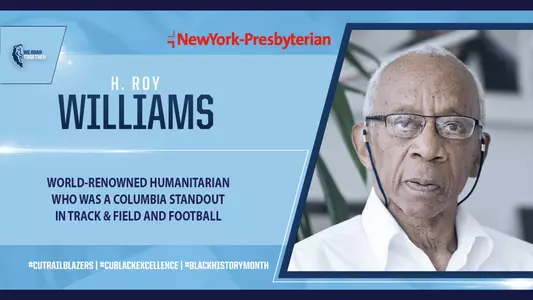
Columbia Trailblazer: H. Roy Williams '53CC
2/18/2021 11:00:00 AM | General, Track and Field
World-renowned humanitarian Howard Roy Williams was a track and field and football standout at Columbia from 1951-53.
BLACK HISTORY MONTH—Before Howard Roy Williams became one of the world's most renowned and respected humanitarians, he made his mark as a standout track and field runner and football player at Columbia.
Born and raised in New York City, Williams earned a Bachelor's degree from Columbia University in 1953, where he competed on the track team and played football, and attended Columbia's Law School. On the track, Williams was a middle distance runner for Columbia from 1951-53. He competed mostly in middle distance events such as the 440-yard run and mid-distance relay events including the one-mile relay and two-mile relay. He led the Lions to a superb second-place finish in two-mile relay at the Milrose Games in 1952. During the fall, he played football for Coach Lou Little.
Williams also served in the United States Army and Army Reserves from 1955 to 1963.
 The majority of his life was dedicated to his career in the field of international humanitarian aid and emergency response. During his career, Williams was appointed Director of the Office of U.S. Foreign Disaster Assistance, Bureau for Humanitarian Response (BHR/OFDA), of the U.S. Agency for International Development (USAID). His work took him around the world, across Europe, Asia, Africa, the Americas and the Middle East.
Early in his career, he served with the International Organization for Migration (IOM), formerly known as the International Committee for European Migration (ICEM), in Malaysia, Thailand, and Geneva, Switzerland, where he served as Chief of Operations from 1983-85.
From 1985-98, he worked with the International Rescue Committee (IRC) as Director of Operations, Vice President for Overseas Programs, and Vice President for Overseas Policy and Planning for 12 years. During this time, he led efforts that resulted in the conceptualization, creation, and staffing of IRC's Emergency Preparedness Unit. He helped to establish and staff IRC offices in Northern Iraq, Jordan, the Balkans, Kenya, Malawi, Rwanda, and southern Sudan, among other areas of the world.
From 1998 to 2001, he was Director of the Office of US Foreign Disaster Assistance, Bureau for Humanitarian Response (BHR/OFDA) of the Agency for International Development (USAID), overseeing disaster preparedness and relief and rehabilitation programs throughout the world.
Williams then served as President and CEO of the Center for Humanitarian Cooperation, an organization focused on achieving coordination in humanitarian work through enhanced cooperation.
In addition to his work, Williams served as an adjunct professor at Columbia University's School of International and Public Affairs. He has also lectured at the Monterey Institute of International Studies in Monterey, Calif.; the American University in Washington, D.C.; and the University Swiss Italia in Lugano, Switzerland. He has designed and led crisis preparedness and response simulations in various locations for the NOHA network of European universities, hosted in the Netherlands.
Known by friends, family, and colleagues as Roy, Williams was an exceptionally intelligent, committed, athletic and compassionate man. He lived a life of curiosity, introspection, integrity, and discipline, and was cherished by his family, friends, and colleagues alike.
Williams passed away on September 25, 2019. He is survived by his wife of 37 years, Carol Weeg and his four children.
Born and raised in New York City, Williams earned a Bachelor's degree from Columbia University in 1953, where he competed on the track team and played football, and attended Columbia's Law School. On the track, Williams was a middle distance runner for Columbia from 1951-53. He competed mostly in middle distance events such as the 440-yard run and mid-distance relay events including the one-mile relay and two-mile relay. He led the Lions to a superb second-place finish in two-mile relay at the Milrose Games in 1952. During the fall, he played football for Coach Lou Little.
Williams also served in the United States Army and Army Reserves from 1955 to 1963.
The majority of his life was dedicated to his career in the field of international humanitarian aid and emergency response. During his career, Williams was appointed Director of the Office of U.S. Foreign Disaster Assistance, Bureau for Humanitarian Response (BHR/OFDA), of the U.S. Agency for International Development (USAID). His work took him around the world, across Europe, Asia, Africa, the Americas and the Middle East.Early in his career, he served with the International Organization for Migration (IOM), formerly known as the International Committee for European Migration (ICEM), in Malaysia, Thailand, and Geneva, Switzerland, where he served as Chief of Operations from 1983-85.
From 1985-98, he worked with the International Rescue Committee (IRC) as Director of Operations, Vice President for Overseas Programs, and Vice President for Overseas Policy and Planning for 12 years. During this time, he led efforts that resulted in the conceptualization, creation, and staffing of IRC's Emergency Preparedness Unit. He helped to establish and staff IRC offices in Northern Iraq, Jordan, the Balkans, Kenya, Malawi, Rwanda, and southern Sudan, among other areas of the world.
From 1998 to 2001, he was Director of the Office of US Foreign Disaster Assistance, Bureau for Humanitarian Response (BHR/OFDA) of the Agency for International Development (USAID), overseeing disaster preparedness and relief and rehabilitation programs throughout the world.
Williams then served as President and CEO of the Center for Humanitarian Cooperation, an organization focused on achieving coordination in humanitarian work through enhanced cooperation.
In addition to his work, Williams served as an adjunct professor at Columbia University's School of International and Public Affairs. He has also lectured at the Monterey Institute of International Studies in Monterey, Calif.; the American University in Washington, D.C.; and the University Swiss Italia in Lugano, Switzerland. He has designed and led crisis preparedness and response simulations in various locations for the NOHA network of European universities, hosted in the Netherlands.
Known by friends, family, and colleagues as Roy, Williams was an exceptionally intelligent, committed, athletic and compassionate man. He lived a life of curiosity, introspection, integrity, and discipline, and was cherished by his family, friends, and colleagues alike.
Williams passed away on September 25, 2019. He is survived by his wife of 37 years, Carol Weeg and his four children.



Feature: National Girls & Women in Sports Day Panel
Wednesday, February 04
Lions Rewind: Sept. 26 - Oct. 24, 2025
Wednesday, November 05
ROARfest
Friday, October 10
Lions Rewind: Sept. 1-25, 2025
Wednesday, October 01